INTRODUCTION
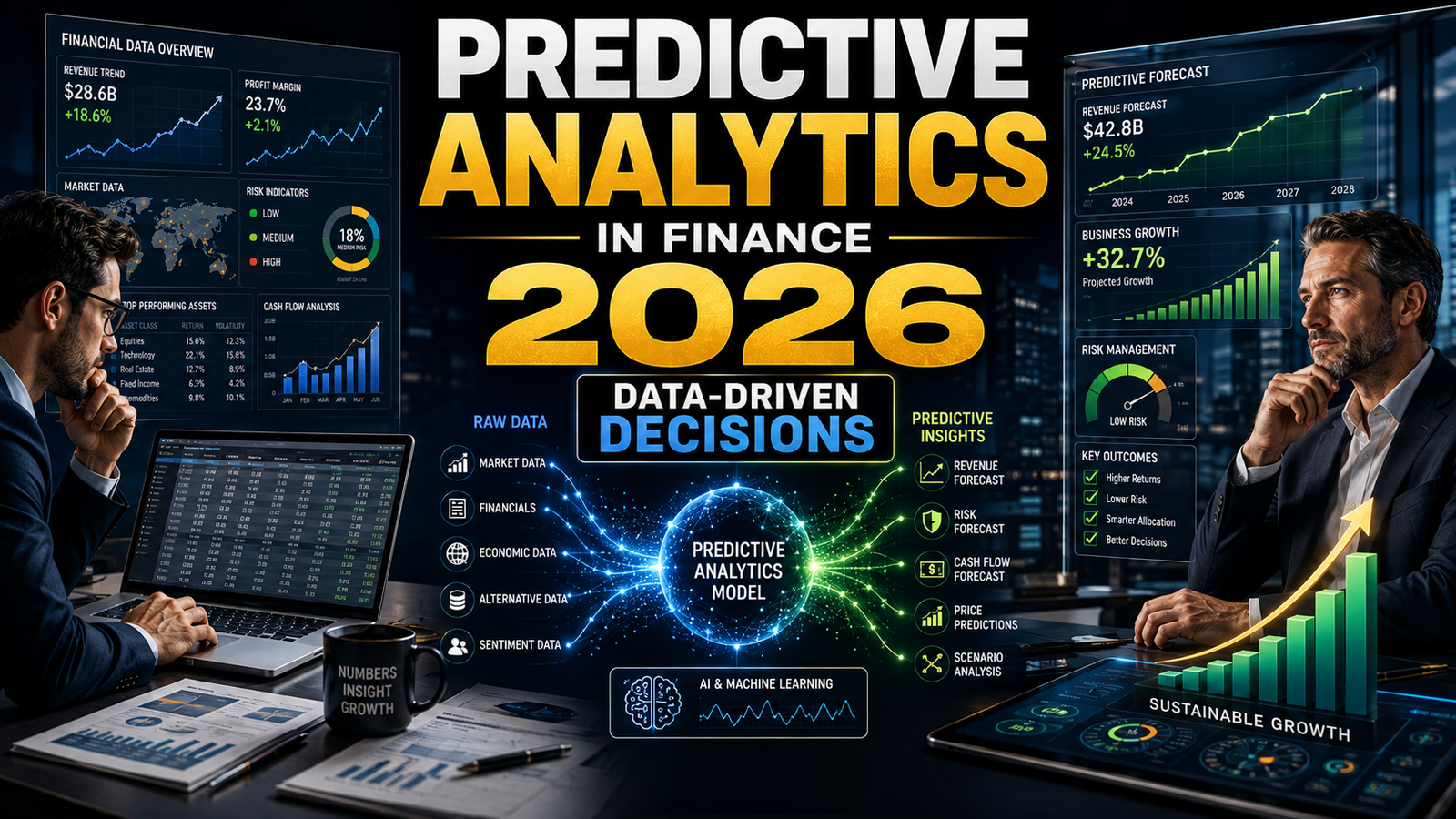
Imagine being able to see into the future of financial markets, customer behavior, and business performance. While no one has a crystal ball, predictive analytics comes remarkably close. By leveraging historical data, statistical algorithms, and machine learning techniques, financial institutions and businesses can forecast outcomes with increasing accuracy.
According to a 2025 report by Gartner, organizations using predictive analytics in finance have seen a 25% improvement in decision-making speed and a 15% increase in profitability. The global predictive analytics market is projected to reach $45 billion by 2027, with financial services accounting for the largest share of adoption.
In 2026, predictive analytics is no longer a luxury for tech-savvy companies – it has become a necessity. From fraud detection and credit scoring to investment strategies and risk management, predictive analytics is transforming how financial decisions are made. Banks, hedge funds, insurance companies, and even individual investors are using data-driven insights to gain a competitive edge.
In this complete guide, we will walk you through everything you need to know about predictive analytics in finance. You will learn what it is, why it matters in today’s data-driven economy, how it works, key applications, the tools and technologies involved, implementation challenges, and future trends. By the end, you will understand how predictive analytics can revolutionize financial decision-making.
WHAT IS PREDICTIVE ANALYTICS IN FINANCE?
Predictive analytics is the practice of using historical data, statistical modeling, and machine learning algorithms to identify patterns and predict future outcomes. In finance, predictive analytics takes this concept and applies it to financial data to forecast market movements, assess creditworthiness, detect fraud, optimize portfolios, and more.
Unlike descriptive analytics, which tells you what happened, or diagnostic analytics, which explains why something happened, predictive analytics focuses on what is likely to happen in the future. It transforms raw data into actionable foresight.
Key components of predictive analytics in finance include:
- Historical data: Past financial transactions, market prices, customer behavior, and economic indicators
- Statistical algorithms: Regression analysis, time series forecasting, and classification models
- Machine learning: Neural networks, random forests, gradient boosting, and deep learning
- Feature engineering: Identifying and selecting the most relevant variables for prediction
- Model validation: Testing predictions against real outcomes to ensure accuracy
The ultimate goal of predictive analytics in finance is to reduce uncertainty and improve decision-making. By quantifying probabilities and identifying patterns, financial professionals can make more informed choices about lending, investing, pricing, and risk management.
WHY PREDICTIVE ANALYTICS MATTERS IN 2026
Several factors make predictive analytics more critical in 2026 than ever before.
Explosion of Financial Data
The amount of financial data generated daily is staggering. Stock exchanges process billions of transactions, credit card companies handle millions of purchases, and social media generates endless sentiment signals. Predictive analytics helps turn this data deluge into meaningful insights.
Increasing Market Volatility
Geopolitical tensions, inflationary pressures, and technological disruptions have made financial markets more volatile. Predictive analytics allows investors and institutions to anticipate market movements and adjust strategies proactively rather than reactively.
Rising Fraud and Cybersecurity Threats
Financial fraud cost businesses over $40 billion globally in 2025. Predictive analytics enables real-time fraud detection by identifying anomalous patterns and high-risk transactions before losses occur.
Regulatory Pressure
Financial regulators increasingly expect institutions to demonstrate robust risk management practices. Predictive analytics provides the quantitative evidence needed to satisfy compliance requirements.
Customer Expectations
Consumers expect personalized financial services. Predictive analytics helps banks and fintech companies offer tailored products, customized interest rates, and proactive financial advice.
Competitive Advantage
In a crowded marketplace, organizations that leverage predictive analytics make faster, more accurate decisions. This translates to better returns, lower costs, and higher customer satisfaction.
HOW PREDICTIVE ANALYTICS WORKS – STEP BY STEP
The predictive analytics process follows a systematic methodology. Understanding each step is essential for successful implementation.
Step 1: Define the Business Problem
The first step is to clearly articulate what you want to predict and why. Examples include:
- Will this borrower default on their loan?
- What will the stock price be in 30 days?
- Which customers are likely to churn?
- What is the optimal price for this financial product?
Step 2: Data Collection and Integration
Gather relevant historical data from multiple sources – internal databases, external data providers, market feeds, and third-party APIs. The quality and completeness of data directly impact prediction accuracy.
Step 3: Data Cleaning and Preparation
Raw data is often messy, containing missing values, duplicates, outliers, and inconsistencies. Data preparation involves:
- Handling missing data through imputation or deletion
- Removing duplicates and irrelevant variables
- Normalizing or scaling numerical data
- Encoding categorical variables
- Detecting and handling outliers
Step 4: Exploratory Data Analysis (EDA)
Explore the data to understand patterns, correlations, and distributions. Visualization tools like histograms, scatter plots, and heatmaps reveal relationships between variables and identify potential predictors.
Step 5: Feature Engineering and Selection
Create new variables that capture important relationships and select the most predictive features. Common techniques include:
- Creating ratios, interaction terms, or lagged variables
- Using domain knowledge to identify key indicators
- Applying automated feature selection methods
Step 6: Model Selection
Choose the appropriate algorithm based on the problem type:
- Regression models: For predicting continuous outcomes
- Classification models: For binary or categorical outcomes
- Time series models: For forecasting over time
- Clustering models: For identifying natural groupings
Step 7: Model Training and Validation
Split data into training and testing sets. Train the model on the training data and validate it on the testing data to assess performance. Use cross-validation to ensure robustness.
Step 8: Model Evaluation
Evaluate model performance using relevant metrics:
- For regression: RMSE, MAE, R-squared
- For classification: Accuracy, Precision, Recall, F1-Score, AUC-ROC
- For forecasting: MAPE, MASE
Step 9: Deployment and Monitoring
Deploy the model into production and monitor its performance over time. Models can degrade as market conditions change, so regular monitoring and retraining are essential.
KEY APPLICATIONS OF PREDICTIVE ANALYTICS IN FINANCE
Predictive analytics has a wide range of applications across the financial sector.
Credit Scoring and Lending
Banks and fintech lenders use predictive models to assess borrower creditworthiness. By analyzing credit history, income, employment, spending patterns, and alternative data, models predict the likelihood of default. This enables faster, more accurate lending decisions and can increase access to credit for underserved populations.
Fraud Detection
Predictive models analyze transaction patterns, device fingerprints, and behavioral data to identify potentially fraudulent activity in real time. Anomalies such as unusual spending locations, large transactions, or atypical patterns trigger alerts, allowing institutions to block suspicious activity before losses occur.
Investment and Portfolio Management
Quantitative investment firms use predictive analytics to forecast stock prices, identify market trends, and optimize portfolios. Machine learning models analyze historical prices, economic indicators, earnings reports, and alternative data like social media sentiment to generate trading signals.
Risk Management
Financial institutions use predictive analytics to assess and mitigate various risks – credit risk, market risk, operational risk, and liquidity risk. Stress testing and scenario analysis help institutions prepare for adverse conditions.
Customer Churn Prediction
Banks and insurance companies use predictive models to identify customers at risk of leaving. By analyzing usage patterns, transaction history, and customer service interactions, institutions can proactively offer incentives or improve service to retain valuable clients.
Pricing Optimization
Predictive analytics helps financial institutions set optimal prices for products and services. By forecasting demand, price sensitivity, and competitive dynamics, companies can maximize revenue and profitability.
Algorithmic Trading
High-frequency trading firms use predictive models to execute trades in milliseconds based on real-time data. These models analyze market microstructure, order flow, and price movements to identify profitable opportunities.
Insurance Underwriting
Insurance companies use predictive analytics to assess risk, set premiums, and detect fraudulent claims. Telematics data from vehicles, health data from wearables, and property data from smart sensors enable more accurate underwriting.
TOOLS AND TECHNOLOGIES FOR PREDICTIVE ANALYTICS
The predictive analytics ecosystem includes a wide range of tools and technologies.
Programming Languages
- Python: The most popular language for data science, with libraries like Pandas, NumPy, Scikit-learn, TensorFlow, and PyTorch
- R: Widely used in academic and quantitative finance for statistical modeling
- SQL: Essential for data extraction and querying
Machine Learning Platforms
- Scikit-learn: Comprehensive library for classical machine learning
- XGBoost and LightGBM: Gradient boosting frameworks for high-performance predictions
- TensorFlow and PyTorch: Deep learning frameworks for complex models
- H2O.ai: Auto-ML platform for automated model selection
Data Visualization and BI Tools
- Tableau: Interactive dashboards for financial analytics
- Power BI: Microsoft’s business intelligence platform
- Looker: Data visualization and exploration
Cloud Platforms
- AWS: SageMaker for model building, S3 for data storage
- Google Cloud: Vertex AI, BigQuery for large-scale analytics
- Azure: Machine Learning Studio, Data Lake
Specialized Financial Analytics Platforms
- Bloomberg Terminal: Real-time market data and analytics
- FactSet and Refinitiv: Financial data and analytics platforms
- Alteryx: Data preparation and blending for analysts
CHALLENGES AND LIMITATIONS
Despite its power, predictive analytics faces several challenges in finance.
Data Quality Issues
Predictive models are only as good as the data they are trained on. Incomplete, inconsistent, or biased data can lead to inaccurate predictions. Financial data often contains missing values, outliers, and errors that require careful handling.
Overfitting
Models that perform well on historical data may fail in real-world applications. Overfitting occurs when a model learns noise rather than signal. Techniques like cross-validation and regularization help mitigate this risk.
Model Interpretability
Black-box models, particularly deep learning, can make accurate predictions but are difficult to interpret. Regulators and stakeholders often demand explainability. Balancing accuracy and interpretability is an ongoing challenge.
Regulatory Compliance
Financial regulations, such as Basel III, GDPR, and the Fair Credit Reporting Act, impose constraints on the use of personal data and model governance. Ensuring compliance while leveraging predictive analytics requires careful navigation.
Changing Market Conditions
Financial markets are dynamic, and models trained on historical data may become outdated. Market shifts, economic policy changes, or black swan events can render predictions unreliable.
Ethical Concerns
Predictive models can inadvertently perpetuate or amplify biases present in historical data. Fair lending, equitable pricing, and non-discriminatory practices require ethical model development and ongoing monitoring.
BEST PRACTICES FOR IMPLEMENTATION
To maximize the value of predictive analytics in finance, follow these best practices.
Start with a Clear Business Objective
Do not deploy analytics for its own sake. Align predictive modeling with specific business problems, such as reducing default rates, increasing returns, or improving customer retention.
Prioritize Data Governance
Establish robust data management practices, including data quality monitoring, security protocols, and compliance frameworks. High-quality, well-governed data is the foundation of effective predictive analytics.
Invest in Talent
Predictive analytics requires a blend of skills – data science, domain expertise in finance, and business acumen. Build a cross-functional team with diverse capabilities.
Emphasize Explainability
Whenever possible, choose interpretable models or implement explainability tools. Stakeholders and regulators need to understand how predictions are generated.
Monitor and Retrain Models Continuously
Set up automated monitoring to track model performance over time. Retrain models regularly with fresh data to maintain accuracy.
Foster a Data-Driven Culture
Encourage decision-makers to trust and act on predictive insights. Provide training, communicate results effectively, and demonstrate the value of data-driven decisions.
FUTURE TRENDS IN PREDICTIVE ANALYTICS FOR FINANCE
Several trends are shaping the future of predictive analytics in finance.
AI and Deep Learning Advancements
Deep learning models are becoming more powerful and accessible. They can uncover complex, non-linear relationships in financial data that traditional models miss.
Alternative Data
Financial institutions are increasingly leveraging alternative data sources – social media sentiment, satellite images, credit card transactions, and web scraping – to enhance predictions.
Real-Time Analytics
The shift from batch processing to real-time predictive analytics enables instant decision-making in trading, fraud detection, and customer engagement.
Explainable AI (XAI)
Regulatory pressure and stakeholder demand for transparency are driving the development of explainable AI tools that clarify model decisions.
Automated Machine Learning (AutoML)
AutoML platforms make predictive analytics accessible to non-experts by automating model selection, feature engineering, and hyperparameter tuning.
Edge Computing
Processing predictive models on edge devices, such as IoT sensors and mobile phones, reduces latency and enables real-time financial applications.
FREQUENTLY ASKED QUESTIONS
What is predictive analytics in finance?
Predictive analytics in finance uses historical data, statistical algorithms, and machine learning to forecast future financial outcomes, such as market movements, credit risk, fraud, and customer behavior.
How does predictive analytics differ from business intelligence?
Business intelligence focuses on understanding historical data and current performance through dashboards and reports. Predictive analytics uses historical data to forecast future outcomes.
What are the most common predictive analytics applications in finance?
Common applications include credit scoring, fraud detection, portfolio optimization, algorithmic trading, risk management, churn prediction, and insurance underwriting.
Do I need a data science team to implement predictive analytics?
While a data science team is ideal, many financial institutions use AutoML platforms that simplify model development. However, domain expertise in finance remains essential.
How accurate are predictive analytics models in finance?
Accuracy varies by application and data quality. Well-designed models can achieve high accuracy, but all predictions carry uncertainty. Regular validation and monitoring are essential.
What is the role of machine learning in predictive analytics?
Machine learning automates pattern recognition and can identify complex relationships that traditional statistical methods miss. It is essential for handling large, high-dimensional financial data.
How are predictive analytics models validated in finance?
Models are validated using historical testing data, backtesting, cross-validation, and out-of-sample testing. Continuous monitoring in production ensures ongoing accuracy.
CONCLUSION
Predictive analytics is revolutionizing the financial industry. By transforming historical data into foresight, it enables faster, more accurate decisions, reduces risk, uncovers opportunities, and delivers competitive advantages. In 2026, predictive analytics is not optional – it is essential for survival and success in the data-driven financial landscape.
However, successful implementation requires more than technology. It demands clear business objectives, high-quality data, skilled talent, ethical practices, and ongoing monitoring. The organizations that master predictive analytics will lead the industry.
Whether you are a financial institution, a fintech startup, or an individual investor, understanding predictive analytics is a vital skill in today’s financial world. Start small, build on successes, and embrace data-driven decision-making to navigate the uncertainties of the future.
Explore more data science and financial technology guides on Akashhelps.com.
Disclaimer: This content is for informational and educational purposes only and does not constitute professional financial or investment advice. Predictive analytics models are tools to assist decision-making, not guarantees of future outcomes. Always consult with qualified financial professionals before making investment or financial decisions. Akashhelps.com is not responsible for any losses or damages resulting from the use of this information.
Author Bio: This guide was written by the finance content team at Akashhelps.com, with expertise in data science, financial modeling, and predictive analytics. We are committed to providing accessible, accurate, and actionable financial education.
Last reviewed: August 2026
Sources:
- Gartner – Analytics and Data Science Market Report 2025
- McKinsey & Company – How AI is Reshaping Financial Services
- World Economic Forum – Data-Driven Decision Making in Finance
- Federal Reserve – Supervisory Guidance on Model Risk Management
- Deloitte – Predictive Analytics in Banking Survey 2025