INTRODUCTION
Financial reporting is the language of business. It is how companies communicate their financial performance and position to investors, creditors, regulators, and other stakeholders. Without accurate and transparent financial reporting, capital markets would grind to a halt, and business decisions would be made in the dark.
According to a 2025 survey by PwC, 78% of institutional investors consider financial reporting quality a critical factor in their investment decisions. Furthermore, the global financial reporting and compliance market is expected to reach $15 billion by 2027, reflecting the growing importance of transparency and regulatory adherence.
In 2026, financial reporting is evolving rapidly. New accounting standards, sustainability reporting requirements, digital transformation, and real-time reporting are reshaping the landscape. Companies must navigate complex regulations while meeting stakeholder expectations for clarity, timeliness, and accuracy.
In this complete guide, we will walk you through everything you need to know about financial reporting. You will learn what it is, why it matters, the key financial statements, regulatory standards, common challenges, best practices, and future trends. By the end, you will have a comprehensive understanding of financial reporting and its critical role in business success.
WHAT IS FINANCIAL REPORTING?
Financial reporting is the process of producing and disseminating financial information about a company to external and internal stakeholders. It encompasses a range of documents, including financial statements, management commentary, footnotes, and supplementary disclosures.
The primary purpose of financial reporting is to provide a true and fair view of a company’s financial health. This information enables stakeholders to make informed decisions about investing, lending, regulatory compliance, and strategic planning.
Key characteristics of financial reporting include:
- Relevance: Information must be useful for decision-making
- Reliability: Information must be accurate and verifiable
- Comparability: Information should be comparable across periods and companies
- Consistency: Information should use consistent accounting policies
- Timeliness: Information must be available in time for decision-making
- Understandability: Information should be presented clearly for users with reasonable financial literacy
Financial reporting is governed by regulatory frameworks, accounting standards, and legal requirements that vary by jurisdiction. In the United States, the Securities and Exchange Commission (SEC) oversees public company reporting, while the Financial Accounting Standards Board (FASB) sets accounting standards. Internationally, the International Accounting Standards Board (IASB) sets International Financial Reporting Standards (IFRS).
WHY FINANCIAL REPORTING MATTERS IN 2026
Several factors make financial reporting more critical in 2026 than ever before.
Investor Demand for Transparency
Investors are demanding greater transparency and more detailed disclosures. They want to understand not just historical performance but also forward-looking information, risk factors, and environmental, social, and governance (ESG) metrics. Companies that provide high-quality financial reporting attract more investment and benefit from lower costs of capital.
Regulatory Complexity
The regulatory environment for financial reporting has become increasingly complex. New standards, such as the SEC’s climate disclosure rules and updated lease accounting standards, require companies to invest heavily in compliance. Failure to comply can result in fines, reputational damage, and legal liability.
Digital Transformation
Technology is transforming financial reporting. Automation, artificial intelligence, and blockchain are enabling real-time reporting, reducing errors, and improving efficiency. However, they also bring challenges related to data security, system integration, and workforce skills.
Sustainability and ESG Reporting
Non-financial reporting, particularly ESG disclosures, has become increasingly important. Stakeholders want to know about companies’ environmental impact, social responsibility, and governance practices. Integrated reporting that combines financial and non-financial information is gaining traction.
Globalization
As businesses operate across borders, the need for consistent, comparable financial reporting has grown. IFRS is now adopted or converged in over 140 countries, enabling cross-border investment and multinational operations.
Economic Uncertainty
Economic volatility, inflation, and geopolitical risks make timely, accurate financial reporting essential. Stakeholders need reliable information to assess risks, adjust strategies, and build confidence.
THE KEY FINANCIAL STATEMENTS
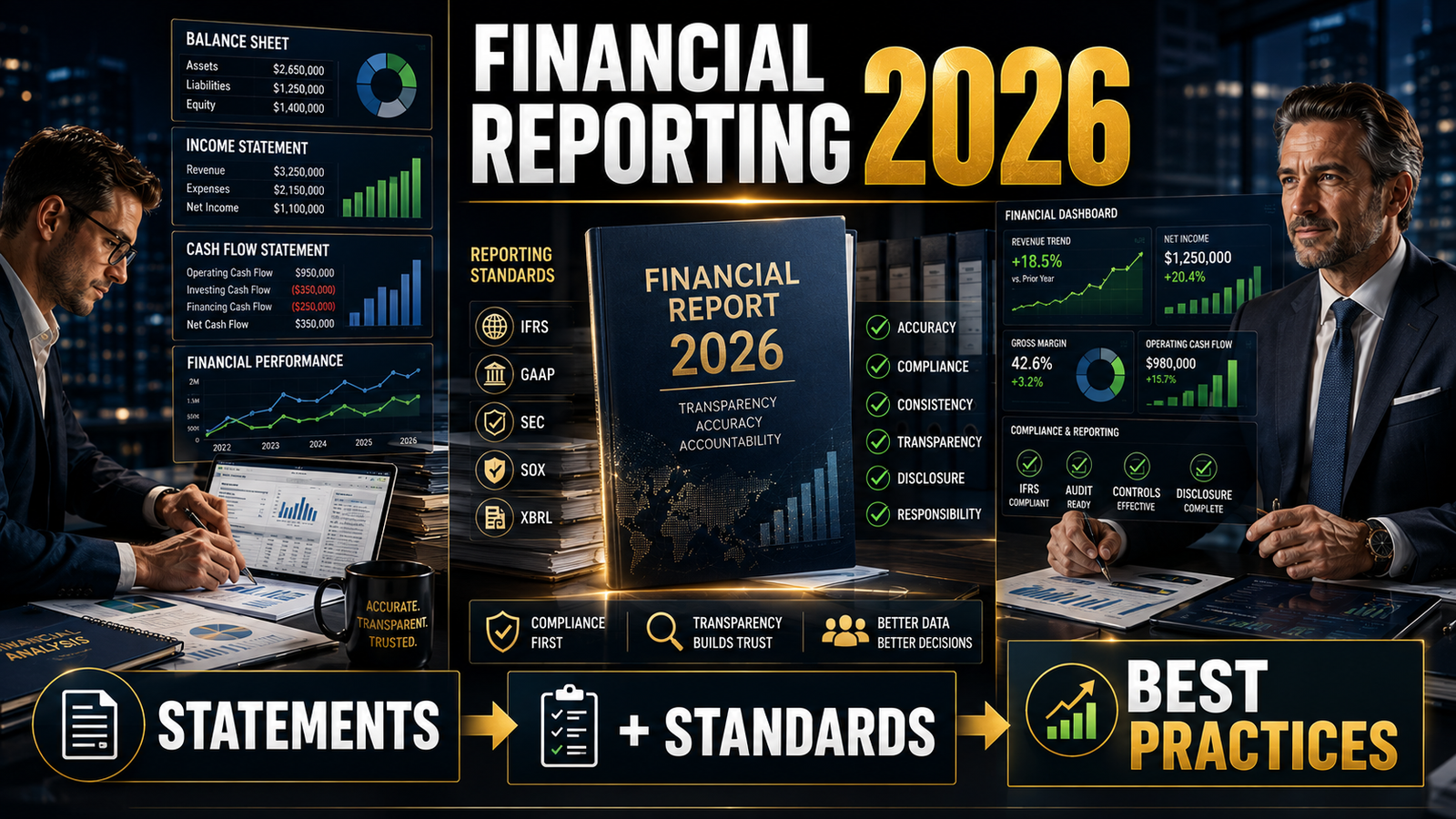
Financial reporting centers around four primary financial statements. Each serves a distinct purpose and provides unique insights.
1. Balance Sheet (Statement of Financial Position)
The balance sheet provides a snapshot of a company’s financial position at a specific point in time. It follows the fundamental accounting equation:
Assets = Liabilities + Shareholders’ Equity
- Assets: Resources owned or controlled by the company (cash, inventory, property, equipment, accounts receivable)
- Liabilities: Obligations owed to external parties (loans, accounts payable, accrued expenses)
- Shareholders’ Equity: The residual interest in assets after deducting liabilities (common stock, retained earnings, additional paid-in capital)
The balance sheet helps stakeholders assess liquidity, solvency, and capital structure. It answers questions like: Does the company have enough assets to cover its debts? How is the company financed – through debt or equity?
2. Income Statement (Statement of Profit and Loss)
The income statement reports a company’s financial performance over a period of time, typically a quarter or a year. It summarizes revenues, expenses, gains, and losses to arrive at net income or net loss.
Revenue – Expenses = Net Income
- Revenue: Income from primary business activities
- Cost of Goods Sold (COGS): Direct costs of producing goods or services
- Gross Profit: Revenue minus COGS
- Operating Expenses: Selling, general, and administrative expenses
- Operating Income: Gross profit minus operating expenses
- Net Income: Total revenue minus total expenses (the “bottom line”)
The income statement helps stakeholders assess profitability, operational efficiency, and earnings quality. It answers questions like: Is the company profitable? How efficiently does it generate profits?
3. Cash Flow Statement
The cash flow statement reports a company’s cash inflows and outflows over a period of time. It is divided into three sections:
- Operating Activities: Cash generated from core business operations (receipts from customers, payments to suppliers and employees)
- Investing Activities: Cash used for or generated from investments (purchase or sale of property, equipment, securities)
- Financing Activities: Cash from or used for financing activities (borrowing, repaying debt, issuing or repurchasing stock, paying dividends)
The cash flow statement answers critical questions: Does the company generate sufficient cash to sustain operations? Is it investing in growth? How is it financing its activities?
4. Statement of Shareholders’ Equity
This statement shows changes in shareholders’ equity over a reporting period. It includes:
- Beginning equity balance
- Net income (or loss)
- Dividends paid
- Issuance or repurchase of stock
- Other comprehensive income or losses
- Ending equity balance
This statement helps stakeholders understand how a company’s ownership value has changed and what factors drove those changes.
REGULATORY STANDARDS AND FRAMEWORKS
Financial reporting operates within a complex regulatory framework.
GAAP (Generally Accepted Accounting Principles)
GAAP is the accounting standard used in the United States. It is established by the Financial Accounting Standards Board (FASB) and enforced by the SEC. GAAP provides detailed guidance on recognition, measurement, presentation, and disclosure of financial information.
IFRS (International Financial Reporting Standards)
IFRS is the global accounting standard used in over 140 countries. It is established by the International Accounting Standards Board (IASB). IFRS is principles-based, providing general guidelines rather than detailed rules.
SEC Regulations
The SEC requires public companies to file annual reports (Form 10-K), quarterly reports (Form 10-Q), and current reports (Form 8-K) for material events. These filings are publicly available through the EDGAR database.
Sarbanes-Oxley Act (SOX)
Enacted in 2002, SOX mandates internal control assessments and certifications by management and external auditors. It aims to protect investors from fraudulent financial reporting.
ESG and Sustainability Reporting Standards
New frameworks like the Sustainability Accounting Standards Board (SASB) and the Task Force on Climate-related Financial Disclosures (TCFD) are gaining prominence. The International Sustainability Standards Board (ISSB) is also developing global sustainability disclosure standards.
COMMON CHALLENGES IN FINANCIAL REPORTING
Companies face numerous challenges in financial reporting.
Data Quality and Integration
Many companies have fragmented data systems that make it difficult to gather accurate, consistent information. Data errors can lead to misstatements, restatements, and regulatory scrutiny.
Complexity of Accounting Standards
GAAP and IFRS are complex and constantly evolving. Keeping up with new standards, such as revenue recognition (ASC 606) and lease accounting (ASC 842), requires significant resources and expertise.
Manual Processes and Human Error
Many finance departments still rely on manual spreadsheets for reporting. This increases the risk of errors, inefficiencies, and delays. Automation can reduce these risks but requires investment and change management.
Time Pressure
Financial reporting deadlines are tight. Public companies must file quarterly reports within 40 days and annual reports within 60 to 90 days. Gathering, validating, and reviewing data under time pressure can compromise quality.
Fraud and Misrepresentation
Deliberate financial misrepresentation, while illegal, remains a concern. Strong internal controls, independent audits, and ethical culture are essential to prevent fraud.
Cybersecurity Threats
Financial data is a prime target for cyberattacks. Data breaches can expose sensitive information, disrupt reporting, and damage stakeholder trust.
BEST PRACTICES FOR EFFECTIVE FINANCIAL REPORTING
To overcome challenges and produce high-quality financial reports, follow these best practices.
Invest in Technology and Automation
Implement modern financial reporting systems that automate data collection, consolidation, and validation. Cloud-based solutions enable real-time reporting and collaboration. Robotic process automation (RPA) can handle repetitive tasks, freeing staff for higher-value analysis.
Strengthen Internal Controls
Establish robust internal controls over financial reporting, including segregation of duties, approval workflows, and reconciliation processes. Regular internal audits identify weaknesses before they become problems.
Build a Strong Finance Team
Hire and retain skilled finance professionals with expertise in accounting standards, data analytics, and regulatory compliance. Ongoing training ensures the team stays current with evolving standards.
Prioritize Data Governance
Implement data governance frameworks that define data ownership, quality standards, and access controls. Master data management ensures consistency across the organization.
Maintain Transparent Communication
Provide clear, concise footnotes and management commentary that explain the numbers, assumptions, and risks. Investors and regulators appreciate transparency and proactive communication.
Engage External Auditors Early
Work closely with external auditors throughout the reporting cycle, not just at the end. Early engagement helps identify issues and ensures smooth completion of the audit.
Conduct Regular Reviews and Reconciliations
Perform periodic reviews of financial data, reconciliations of accounts, and analytical procedures to identify anomalies. Addressing issues early improves accuracy and reduces last-minute stress.
THE ROLE OF TECHNOLOGY IN FINANCIAL REPORTING
Technology is transforming financial reporting across every dimension.
Automation and RPA
Robotic process automation can handle repetitive tasks like data entry, reconciliation, and report generation. This reduces errors and frees finance staff for analysis and strategic work.
Artificial Intelligence (AI)
AI can analyze large datasets, identify patterns, and detect anomalies. AI-powered tools can also assist in drafting footnotes, reviewing contracts for lease or revenue recognition, and predicting financial outcomes.
Blockchain
Blockchain technology offers the potential for immutable, transparent, and real-time financial records. Smart contracts can automate compliance, and distributed ledgers can reduce reconciliation efforts.
Cloud Computing
Cloud-based reporting solutions enable real-time collaboration, scalability, and remote access. They eliminate the need for on-premise infrastructure and provide automatic updates.
Data Visualization
Interactive dashboards and visualization tools make financial data more accessible and understandable. They help stakeholders quickly grasp key trends and insights.
XBRL (eXtensible Business Reporting Language)
XBRL is the standard for electronic financial reporting. It enables machine-readable data, making it easier for regulators, analysts, and investors to analyze and compare financial information.
FUTURE TRENDS IN FINANCIAL REPORTING
Several trends are shaping the future of financial reporting.
Real-Time Reporting
Stakeholders increasingly expect near-real-time financial information. Continuous accounting and real-time reporting are becoming more feasible with advances in technology.
ESG and Integrated Reporting
Sustainability reporting is moving from voluntary to mandatory in many jurisdictions. Companies will need to integrate ESG metrics with traditional financial reporting to meet stakeholder expectations.
Enhanced Audit and Assurance
Auditing is evolving to include data analytics, AI, and continuous monitoring. Expect greater scrutiny of non-financial information and forward-looking statements.
Standardization and Convergence
Efforts to converge GAAP and IFRS are ongoing, though full convergence may be unrealistic. Standardization of ESG reporting frameworks is accelerating.
Democratization of Data
Advanced analytics and visualization tools are making financial data accessible to a broader audience within organizations. Finance professionals are becoming more data-driven and analytical.
Focus on Forward-Looking Information
Stakeholders want more forward-looking information, including forecasts, risk assessments, and scenario analysis. Financial reporting will increasingly incorporate predictive insights.
FREQUENTLY ASKED QUESTIONS
What is financial reporting?
Financial reporting is the process of producing financial statements and disclosures that communicate a company’s financial performance and position to stakeholders.
What are the four main financial statements?
The four main financial statements are the balance sheet, income statement, cash flow statement, and statement of shareholders’ equity.
What is the difference between GAAP and IFRS?
GAAP is the accounting standard used in the United States, while IFRS is the global standard used in over 140 countries. GAAP is rules-based, while IFRS is principles-based.
What is the purpose of financial reporting?
The purpose of financial reporting is to provide a true and fair view of a company’s financial health, enabling stakeholders to make informed investment, lending, and regulatory decisions.
How often are public companies required to report?
Public companies must file quarterly reports (Form 10-Q) and annual reports (Form 10-K) with the SEC. They must also file current reports for material events (Form 8-K).
What is XBRL?
XBRL is a machine-readable format for financial reporting that enables data to be easily analyzed and compared by regulators, analysts, and investors.
How is technology changing financial reporting?
Technology is automating manual processes, enabling real-time reporting, improving data accuracy, and providing advanced analytics and visualization tools.
CONCLUSION
Financial reporting is the backbone of transparency and trust in the business world. In 2026, it is more important than ever as stakeholders demand greater accuracy, timeliness, and breadth of information. Companies that embrace best practices in financial reporting build investor confidence, reduce regulatory risk, and position themselves for long-term success.
The future of financial reporting is evolving rapidly. Technology is enabling real-time, data-driven reporting, while sustainability and ESG disclosures are becoming integral to corporate communication. Companies that invest in modern reporting systems, skilled talent, and ethical governance will thrive in this new environment.
Whether you are a finance professional, a business leader, an investor, or a student, understanding financial reporting is essential. It provides the foundation for informed decision-making and sustainable value creation.
Explore more financial reporting and accounting guides on Akashhelps.com.
Disclaimer: This content is for informational and educational purposes only and does not constitute professional accounting, legal, or regulatory advice. Always consult with qualified accounting professionals and legal advisors regarding your specific financial reporting obligations. Akashhelps.com is not responsible for any losses or damages resulting from the use of this information.
Author Bio: This guide was written by the finance content team at Akashhelps.com, with expertise in financial reporting, accounting standards, and regulatory compliance. We are committed to providing accessible, accurate, and actionable financial education.
Last reviewed: August 2026
Sources:
- Financial Accounting Standards Board (FASB) – Standards
- International Accounting Standards Board (IASB) – IFRS Standards
- U.S. Securities and Exchange Commission (SEC) – Forms and Filings
- PwC – Global Investor Survey 2025
- Deloitte – Financial Reporting Insights 2026