INTRODUCTION
Where do people go for financial advice in 2026? Increasingly, the answer is social media. Platforms like YouTube, TikTok, Instagram, and X (formerly Twitter) have become primary sources of financial information, particularly for younger generations. This shift has created a new research frontier: understanding how social media influences financial literacy, and how it can be leveraged for financial education.
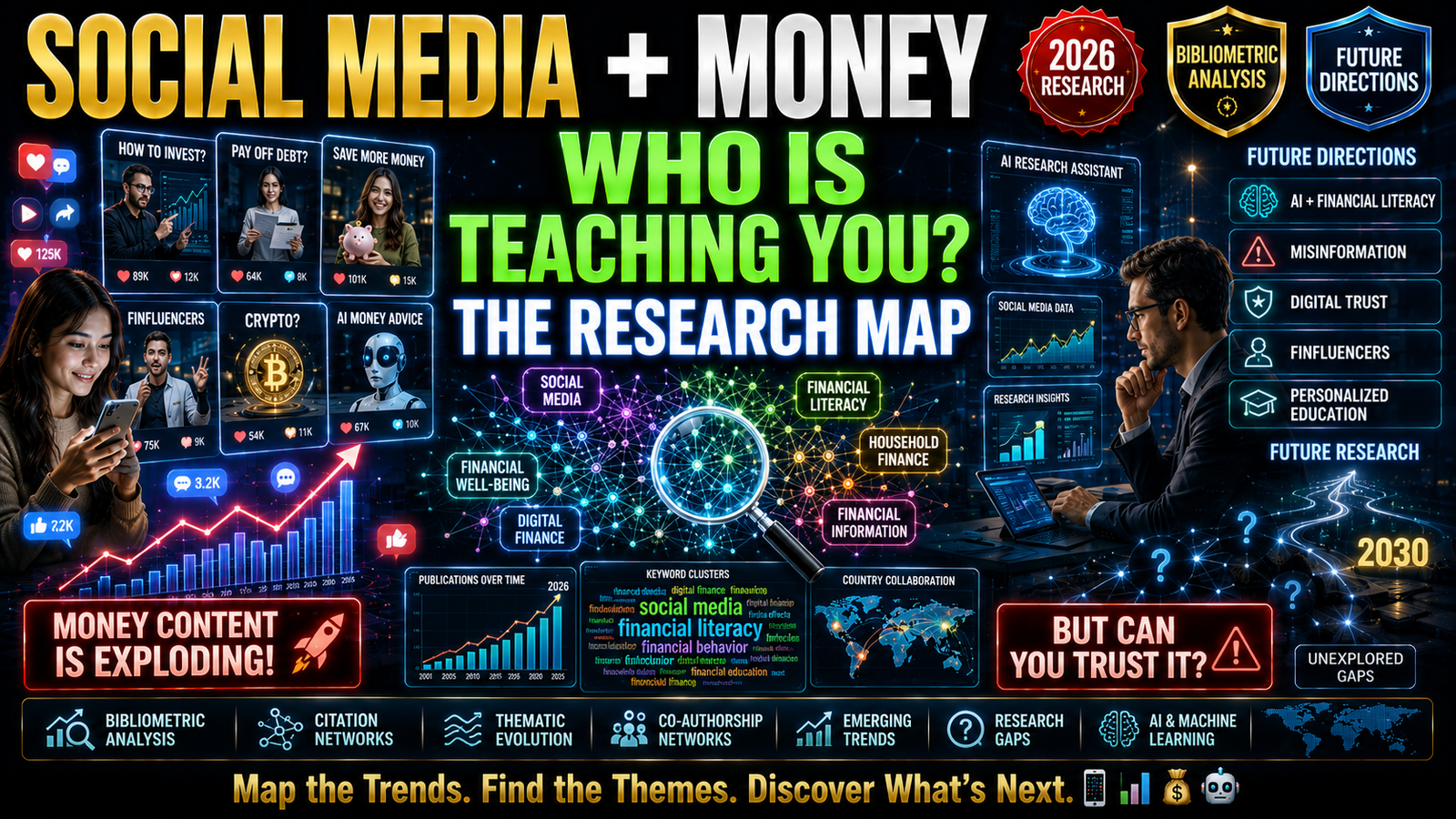
A comprehensive bibliometric analysis of research on social media and financial literacy from 2001 to 2025 reveals a field that has grown significantly, particularly after the 2008 financial crisis and the COVID-19 pandemic. The study, covering 523 journal articles from the Scopus database, maps the intellectual, conceptual, and social structure of this emerging research area. It identifies the most influential authors, countries, and sources, as well as the key themes and trends shaping the field.
In this guide, we will explore the intersection of social media and financial literacy research, examining the trends, knowledge gaps, and practical implications. We will also compare these academic findings with real-world search behavior to understand how people actually seek financial information today.
THE GROWTH OF SOCIAL MEDIA AND FINANCIAL LITERACY RESEARCH
A Gradual Upward Trend
Research on social media and financial literacy has been growing since 2001, with a gradual upward trend in scientific production. Two major events catalyzed this growth:
The 2008 Financial Crisis: After the Great Recession, researchers and policymakers began asking urgent questions about household financial knowledge. The crisis highlighted the consequences of low financial literacy, prompting a wave of research on how people learn about money.
The COVID-19 Pandemic: Post-2020, more attention has been paid to finances, particularly financial well-being and household finance. The pandemic accelerated digital adoption, pushing more people online for financial information and services.
Most Productive Countries
The most productive countries in social media and financial literacy research are:
- United States: The leading producer of research in this area
- China: A significant contributor, reflecting growing interest in digital finance
Sustainability (Switzerland) has emerged as the most productive source journal, indicating the interdisciplinary nature of this research. Several authors have collaborated across institutions and countries, making this a collaborative research area.
The Research Gap
Despite growing interest, significant gaps remain. The study highlights that most research in this area is empirical rather than synthetic. There is a lack of comprehensive bibliometric analysis, which means the field’s intellectual structure, key contributors, and thematic evolution have not been systematically mapped.
This gap is what the bibliometric analysis aims to fill, providing a “bird’s eye view” of scientific production while offering practical implications for policymakers, financial institutions, and banks.
KEY RESEARCH THEMES AND INTELLECTUAL STRUCTURE
Thematic Clusters
The bibliometric analysis reveals several key themes in social media and financial literacy research:
- Financial Literacy and Well-Being: Financial capability, financial education, financial inclusion, and gender differences
- Digital Literacy and Technology: The role of social media platforms in promoting financial literacy
- Behavioral Finance: Psychological factors that influence financial decision-making
- Financial Inclusion: How social media can reach underserved populations
Intellectual Structure
The analysis identifies a collaborative research network, with several authors working together across institutions and countries. This collaboration reflects the interdisciplinary nature of the field, which spans finance, education, psychology, and communication studies.
Conceptual Evolution
Research has evolved from examining basic financial knowledge to exploring how social media shapes financial behavior, attitudes, and well-being. The field is increasingly focused on:
- Financial well-being: How social media affects overall financial health
- Household finance: The role of social media in everyday financial decisions
- Financial resilience: How social media can help people withstand financial shocks
SOCIAL MEDIA AS A FINANCIAL LITERACY TOOL
The Opportunity
Social media offers several advantages for promoting financial literacy:
- Reach: Platforms have billions of users, including demographics that traditional financial education channels often miss
- Engagement: Interactive content (videos, polls, live sessions) can make financial education more engaging
- Accessibility: Free content reduces barriers to financial knowledge
- Relatability: Influencers and peers can make financial topics feel more accessible
The Challenge
However, social media also presents significant challenges:
- Quality and Credibility: Financial information on social media varies widely in quality
- Misinformation: Scams and misleading advice are common
- Algorithmic Bias: Platforms may amplify sensational or misleading content
- Lack of Regulation: Unlike traditional financial advice, social media content is largely unregulated
Implications for Practitioners
The research has practical implications for:
- Policymakers: Using social media for public financial education campaigns
- Financial Institutions: Leveraging social media to build financial literacy among customers
- Banks: Promoting financial inclusion through digital channels
- Educators: Incorporating social media into financial literacy curricula
SEARCH BEHAVIOR AND FINANCIAL LITERACY: WHAT THE DATA REVEALS
The Surge in Financial Curiosity
Google Trends data across eight core personal finance terms reveals a population more financially curious—and more anxious—than ever before. “Investing” commands a search interest score of 73—nearly six times higher than the next most-searched term, “budgeting,” which scores just 13. Personal finance sits at 12, financial planning at 9. The remaining terms—saving money, retirement planning, debt management, and emergency fund—all cluster between 5 and 7.
The gap between investing and everything else is not just large—it is revealing. People are thinking about building wealth far more than they are thinking about the foundations of financial health: budgeting, saving, and debt management.
A New Kind of Searcher
Among the year’s top rising searches sits a single query that stopped analysts in their tracks: “I’m 25 and earning ₹30k a month—how should I start investing for long-term growth?” This query registered as a Breakout term, meaning search interest grew by more than 5,000%. This was not an experienced investor refining a portfolio. This was a beginner—young, likely in an emerging economy—looking for a place to start.
These searchers are not being well-served by mainstream financial media, which continues to speak to the already-initiated. The educational appetite is enormous. The supply of genuinely accessible answers remains thin.
The Anxiety Hedge
Among the fastest-rising investing sub-queries, two stand out for what they reveal about collective unease:
- Investing gold — up 120%
- Gold investing — up 100%
- Real estate investing — up 40%
- Real estate investing news — up an extraordinary 2,500%
These are the search habits of people hedging. When equity markets feel volatile and currencies uncertain, tangible assets reassert their psychological appeal. The data suggests that global inflation anxieties have not faded—they have simply been internalized into everyday behavior.
The AI Crossover
Three of the top Breakout queries under “investing” have nothing to do with stocks, gold, or real estate. They are about OpenAI:
- OpenAI news — Breakout
- AI news today — Breakout
- OpenAI news today — Breakout
The collision of financial anxiety and artificial intelligence in a single search category is not accidental. It reflects a generation trying to make sense of an economy being rewritten in real time—where the rules of employment, income, and wealth are shifting faster than any previous generation has had to absorb. People are not just asking how do I invest. They are asking what world am I investing into.
The Geography of a New Investor Class
The sharpest growth in investing searches is not coming from Wall Street’s backyard. It is coming from everywhere else:
- Investing India — up 180%
- Investing España — up 350%
- Investing Türkiye — up 350%
Emerging economies are experiencing a surge in first-time investors, driven by growing middle classes, widespread mobile internet access, and post-pandemic savings looking for a home. The globalization of financial curiosity is one of the most underreported stories in personal finance right now.
The Uncomfortable Silence Around the Basics
Here is what the data does not show: a surge in searches for the unsexy fundamentals:
- Debt management — 5
- Emergency fund — 5
- Budgeting — 13
These low scores are unlikely to reflect financial health. More probably, they reflect avoidance. Psychologically, people search for aspiration—investing, wealth, returns—far more readily than for the unglamorous work of paying down debt or building a three-month safety net.
The data reflects human nature as much as it reflects financial literacy. We want to skip to the exciting part.
RESEARCH GAPS AND FUTURE DIRECTIONS
Persistent Gaps
The bibliometric analysis identifies several critical research gaps:
- Lack of Bibliometric Studies: Most research in this area is empirical. There is a need for more synthetic studies that map the field’s intellectual structure.
- Interdisciplinary Exploration: More research is needed on the intersection of AI, machine learning, and financial literacy.
- Methodological Diversity: Systematic reviews and meta-analyses are needed to consolidate findings.
- Geographic Gaps: More research is needed in emerging economies and under-researched regions.
Future Research Questions
Based on the evidence, future research should address:
- How do different social media platforms affect financial literacy differently?
- What types of financial content on social media are most effective for learning?
- How can social media be used to reach underserved populations?
- What role does AI play in financial literacy and decision-making?
- How can the quality and credibility of financial information on social media be improved?
FREQUENTLY ASKED QUESTIONS
What is the relationship between social media and financial literacy?
Social media has become a primary source of financial information, particularly for younger generations. Research shows that social media can promote financial literacy, but the quality and credibility of information vary widely.
How has research on social media and financial literacy evolved?
Research has grown significantly since 2001, with major increases after the 2008 financial crisis and the COVID-19 pandemic. The field has shifted from examining basic knowledge to exploring financial well-being, household finance, and digital literacy.
Which countries are most productive in this research?
The United States and China are the most productive countries in social media and financial literacy research. Sustainability (Switzerland) is the most productive source journal.
What are the main themes in this research?
Key themes include financial literacy and well-being, digital literacy, behavioral finance, and financial inclusion. Research is increasingly focused on how social media can promote financial resilience and inclusion.
What are the practical implications of this research?
Policymakers, financial institutions, banks, and educators can use social media to promote financial literacy. However, the quality and credibility of content must be carefully managed.
What are the research gaps in this area?
Key gaps include a lack of bibliometric studies, limited interdisciplinary exploration, and insufficient research in emerging economies. More systematic reviews and meta-analyses are needed.
How does search behavior relate to financial literacy?
Search data reveals a population more financially curious than ever, but with a focus on aspiration rather than fundamentals. People search for investing far more than for budgeting, debt management, or emergency fund topics.
CONCLUSION
The intersection of social media and financial literacy represents one of the most dynamic and important areas of financial research in 2026. As people increasingly turn to digital platforms for financial information, understanding how social media affects financial knowledge, behavior, and well-being is essential.
The research reveals a field that has grown significantly since 2001, driven by major economic events and technological change. The United States and China lead in research production, but emerging economies are driving the most recent growth in financial curiosity and engagement.
Critical gaps remain. More interdisciplinary research is needed, particularly on the role of AI and machine learning in financial literacy. Systematic reviews and meta-analyses could consolidate fragmented findings. Research in emerging economies is essential for understanding digital financial inclusion.
For practitioners, the implications are clear: social media is a powerful tool for promoting financial literacy, but quality and credibility must be ensured. For researchers, the field offers rich opportunities for exploration. For policymakers, it is a channel to reach populations that traditional education often misses.
The demand for accessible, trustworthy financial education has never been greater—and the opportunity to meet it through social media has never been clearer.
Disclaimer: This content is for informational and educational purposes only and does not constitute professional financial advice. Financial literacy empowers decision-making but is not a substitute for professional guidance.