INTRODUCTION
What do 6,314 academic papers, 523 studies on digital fraud, and millions of Google searches have in common? They all tell a story about financial literacy — how it has evolved, where it is heading, and what people are still struggling to understand.
Between 1963 and 2025, research on financial literacy grew from a niche academic interest into a global policy priority. The Great Recession of 2008 and the COVID-19 pandemic acted as catalysts, pushing governments and researchers to ask a urgent question: do households actually understand the financial products available to them?
In 2026, the answer is not reassuring. National surveys show financial literacy at its lowest point in a decade, while search data reveals a world more financially curious — and more anxious — than ever before. Meanwhile, research is shifting from measuring basic knowledge to exploring digital literacy, behavioral finance, and the role of social media in financial education.
This guide presents a bibliometric analysis of financial literacy research, combined with real-world search data, to reveal the trends, gaps, and opportunities in financial education today.
THE STATE OF FINANCIAL LITERACY RESEARCH
The Scale of the Research Landscape
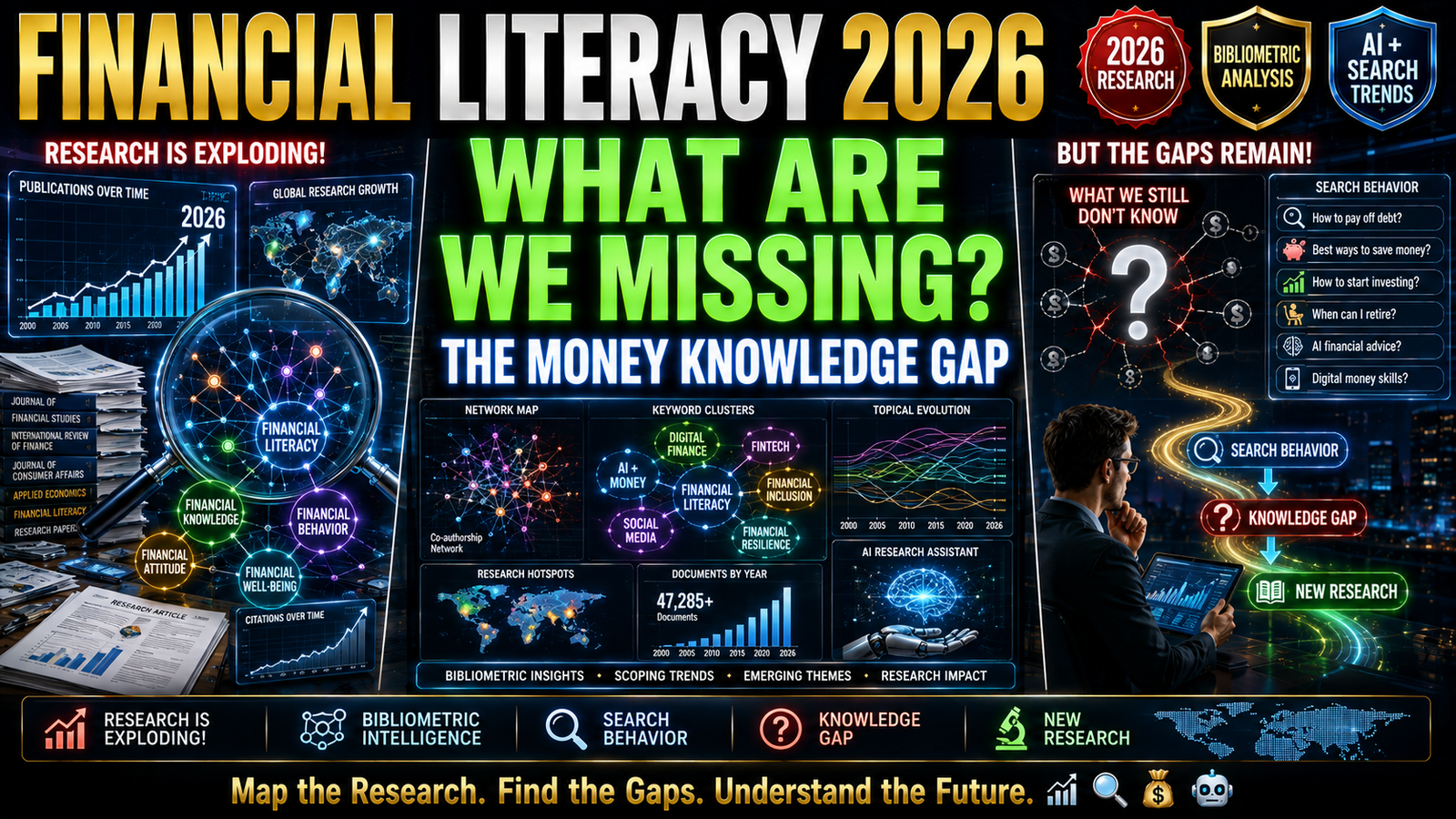
A comprehensive bibliometric analysis of financial literacy research, covering 6,314 documents published between 1963 and 2025, reveals a field that has expanded dramatically in recent years. The starting point of this research is simple: after the Great Recession and again after COVID-19, policymakers kept asking whether households understand the financial products available to them.
Three key findings stand out from this analysis:
- Exponential Growth: Output rises almost exponentially over 2020–2025, pushed by digitalization and the growing visibility of crypto and similar assets.
- Geographic Shift: The leading producing institutions are now in Asia — particularly the University of Malaya — even though the United States still hosts most corresponding authors.
- Thematic Evolution: The field is drifting from the original “Big Three” measurement agenda toward concepts such as financial inclusion, digital literacy, and the behavioral side of household finance.
The Changing Focus of Financial Literacy Research
Bibliometric mapping shows that financial literacy research clusters around three main themes:
- Financial Management and Education: Adult education, financial management, numeracy, and self-control remain foundational topics.
- Financial Literacy and Well-Being: Financial capability, financial education, financial inclusion, and gender differences dominate this cluster.
- Youth Financial Knowledge and Sustainability: Financial systems, retirement planning, training, and young populations are emerging as key areas of focus.
The keyword map tells a story of evolution. Early research focused on measuring basic financial knowledge — the “Big Three” questions about interest rates, inflation, and diversification. Today, researchers are exploring digital literacy, the impact of social media, and the psychological factors that influence financial decision-making.
The Intersection of Digital Fraud and Financial Literacy
A separate bibliometric dataset examining the intersection of digital fraud and financial literacy (2015–2026) analyzed 523 journal articles. This research cluster connects digital-fraud terms — online scams, phishing, identity theft — with financial-literacy and prevention terms like fraud awareness, consumer protection, and digital financial literacy.
This intersection is particularly important in 2026. As financial services move increasingly online, and as cyber threats evolve, financial literacy must include the ability to identify scams, protect personal information, and understand the risks of digital financial products.
WHAT PEOPLE ARE SEARCHING FOR: THE DATA
The Headline Number
Google Trends data across eight core personal finance terms tells a stark story. “Investing” commands a search interest score of 73 — nearly six times higher than the next most-searched term, “budgeting,” which scores just 13. Personal finance sits at 12, financial planning at 9. The remaining terms — saving money, retirement planning, debt management, and emergency fund — all cluster between 5 and 7.
The gap between investing and everything else is not just large — it is revealing. People are thinking about building wealth far more than they are thinking about the foundations of financial health: budgeting, saving, and debt management.
The Most Confusing Financial Terms
When people do search for financial definitions, certain terms consistently confuse them. A 2026 analysis of UK and global search data identified the most puzzling financial jargon:
| Rank | Finance Term | UK Monthly Searches | Global Monthly Searches |
|---|---|---|---|
| 1 | Equity | 17,900 | 247,100 |
| 2 | GDP | 10,400 | 176,800 |
| 3 | ETF | 9,950 | 142,230 |
| 4 | APR | 9,900 | 107,590 |
| 5 | Arrears | 7,650 | 83,260 |
| 6 | Correlation | 6,950 | 71,700 |
| 7 | Yield | 6,200 | 88,250 |
| 8 | Annuity | 3,900 | 77,550 |
| 9 | Principal | 3,400 | 76,750 |
| 10 | Capital | 2,600 | 81,700 |
“Equity” is the most misunderstood financial term worldwide, receiving 247,100 monthly searches for its definition. Despite being frequently mentioned in the news, “GDP” ranks second, drawing 176,800 global searches. “ETF” comes third with 142,230 searches.
The financial confusion has real-world costs. In the UK alone, nearly two-thirds (65%) of adults struggle to grasp common financial terms, costing the average adult £640 every year, and totaling £26 billion across the population.
The Most Searched Financial Terms in the US
In the United States, search data reveals similar patterns. “Financial literacy” commands 33,100 monthly searches in the US, with a cost-per-click of $13.51 — reflecting high commercial intent. Related search terms include:
- “What is financial education” — 6,600 monthly searches
- “Financial education” — 5,400 monthly searches
- “Finance education” — 4,400 monthly searches
- “Define financial literacy” — 4,400 monthly searches
- “Financial literacy meaning” — 4,400 monthly searches
These numbers reveal a population hungry for basic financial knowledge but often struggling to find accessible, trustworthy sources.
The New Kind of Searcher
Among the year’s top rising searches sits a single query that stopped analysts in their tracks: “I’m 25 and earning ₹30k a month — how should I start investing for long-term growth?” This query registered as a Breakout term, meaning search interest grew by more than 5,000%.
This was not an experienced investor refining a portfolio. This was a beginner — young, likely in an emerging economy — looking for a place to start. These searchers are not being well-served by mainstream financial media, which continues to speak to the already-initiated. The educational appetite is enormous. The supply of genuinely accessible answers remains thin.
THE GEOGRAPHY OF FINANCIAL CURIOUSITY
The sharpest growth in investing searches is not coming from Wall Street’s backyard. It is coming from emerging economies:
- Investing India — up 180%
- Investing España — up 350%
- Investing Türkiye — up 350%
These are not just statistics. They represent a globalization of financial curiosity — one of the most underreported stories in personal finance right now. Growing middle classes, widespread mobile internet access, and post-pandemic savings looking for a home are driving first-time investors in regions that have historically had lower financial literacy rates.
Research confirms this geographic shift. Bibliometric analysis shows that leading producing institutions in financial literacy research are now in Asia, with the University of Malaya emerging as a key contributor. However, the United States still accounts for most corresponding authors, indicating a disconnect between research production and the populations where financial curiosity is growing fastest.
THE RESEARCH ON SOCIAL MEDIA AND FINANCIAL LITERACY
The Evolution of Research
Research on social media and financial literacy has been growing since 2001, with a gradual upward trend. Particularly after 2008, scientific production gained significant attention from researchers globally. Post-COVID-19, more attention has been paid to finances — especially financial well-being and household finance.
The most productive countries in this research area are the USA and China, with Sustainability (Switzerland) emerging as the most productive source. Several authors have worked together, making it a collaborative research area.
Research Gaps and Future Directions
Despite growing interest, significant gaps remain. The study of social media and financial literacy lacks comprehensive bibliometric analysis, with most research being empirical rather than synthetic. Areas for future exploration include:
- The use of AI and machine learning in financial literacy research
- Interdisciplinary approaches combining technology and financial education
- The role of social media platforms in promoting financial literacy
- Systematic reviews and meta-analyses to consolidate findings
Implications for Practitioners
The research has practical implications for policymakers, financial institutions, and banks. Social media can be a powerful tool for promoting financial literacy, reaching demographics that traditional education channels often miss. However, the quality and credibility of financial information on social media remains a concern, requiring careful curation and verification.
SEARCH BEHAVIOR AS A FINANCIAL LITERACY MEASURE
The Search-Based Financial Awareness Index
A novel approach to measuring financial literacy uses search-based data derived from Google Trends. Researchers have developed a financial awareness index based on the Search Volume Index (SVI) for topics related to individual retirement accounts (IRAs). This index measures individuals’ awareness of financial topics and their efforts to acquire relevant knowledge.
Key findings from this research include:
- Significant time-series and cross-sectional heterogeneity exists in financial awareness regarding IRA savings.
- Increased financial awareness is associated with greater IRA savings.
- Search-based data complements traditional survey-based measures, offering a solution to data limitations in household finance research.
This methodology can be readily extended to other areas of household finance, providing real-time, behavioral measures of financial literacy that surveys cannot capture.
Google Trends as a Market Predictor
Research has also shown that Google search patterns can predict market movements. A study analyzing Google Trends data found that as searches for words like “debt,” “portfolio,” “stocks,” and “crisis” decreased, the Dow Jones Industrial Average tended to rise. Conversely, increased searches for these terms preceded market declines.
The word with the greatest predictive value was “debt.” If an investor had followed a smart trading strategy based on search term changes between 2004 and 2011, they would have achieved a 326% return — compared to just 16% for a buy-and-hold strategy.
This research underscores the value of search-based data for understanding financial behavior and anticipating market sentiment.
COMMON MISTAKES TO AVOID IN FINANCIAL LITERACY RESEARCH AND EDUCATION
Mistake 1: Focusing Only on Knowledge, Not Behavior
Financial literacy is not just about knowing terms. It is about applying that knowledge. Research shows that knowledge alone does not guarantee better financial outcomes — attitudes and behaviors matter equally.
Mistake 2: Ignoring the Digital Divide
As financial services move online, digital literacy has become inseparable from financial literacy. Those without digital skills are at risk of being excluded from financial services and vulnerable to online scams.
Mistake 3: Assuming One-Size-Fits-All
Financial literacy varies by age, gender, income, and geography. Educational interventions must be tailored to specific audiences.
Mistake 4: Overlooking the Role of Social Media
Social media is where many people now get financial information. Ignoring this channel means missing a key opportunity for financial education.
FREQUENTLY ASKED QUESTIONS
What is bibliometric analysis in financial literacy?
Bibliometric analysis is a quantitative method that examines academic publications to reveal trends, influential authors, key themes, and knowledge gaps in a research field. In financial literacy, it has shown the field’s shift from basic measurement to digital and behavioral topics.
What are the most researched topics in financial literacy?
Current research focuses on financial inclusion, digital literacy, behavioral finance, financial well-being, and youth financial knowledge. The field has moved beyond the “Big Three” questions about interest rates, inflation, and risk diversification.
What is the most misunderstood financial term?
“Equity” is the most confusing financial term worldwide, receiving 247,100 monthly searches for its definition. Other terms that consistently confuse people include GDP, ETF, APR, and arrears.
How much is financial illiteracy costing people?
In the UK, financial illiteracy costs the average adult £640 every year, totaling £26 billion across the population. In the US, those with low financial literacy are four times more likely to struggle to make ends meet.
Where is financial literacy research growing fastest?
Research output has grown exponentially since 2020, driven by digitalization and interest in crypto assets. Leading institutions are now in Asia, particularly the University of Malaya.
How does search data help understand financial literacy?
Search-based data, such as Google Trends, can measure financial awareness in real time. Researchers have used search data to create financial awareness indexes and even predict market movements.
What is the connection between digital fraud and financial literacy?
As financial services move online, digital literacy has become a critical component of financial literacy. Research shows that understanding financial concepts helps individuals identify scams, protect personal information, and make safer financial decisions.
CONCLUSION
Financial literacy research in 2026 reveals a field at a turning point. The evidence from academic publications, search data, and national surveys all points to the same conclusion: financial literacy is essential, yet it remains alarmingly low across populations.
The research landscape has shifted. Traditional models of measuring financial knowledge are giving way to more sophisticated approaches that consider digital literacy, behavioral factors, and the role of social media. Research institutions in Asia are emerging as leaders, reflecting the globalization of financial curiosity and concern.
Search data adds another dimension. People are more financially curious than ever, but they are searching for aspirational topics like investing far more than for foundational topics like budgeting and debt management. The terms that confuse people most — equity, GDP, ETF, APR — reveal where financial education must focus.
The opportunity is clear. Researchers, educators, and policymakers must work together to close the knowledge gap, using the tools of the digital age — social media, search data, and AI — to deliver accessible, trustworthy financial education to a global audience.
Disclaimer: This content is for informational and educational purposes only and does not constitute professional financial advice. Financial literacy empowers decision-making but is not a substitute for professional guidance. Always consult with qualified financial professionals regarding your specific financial situation.