INTRODUCTION
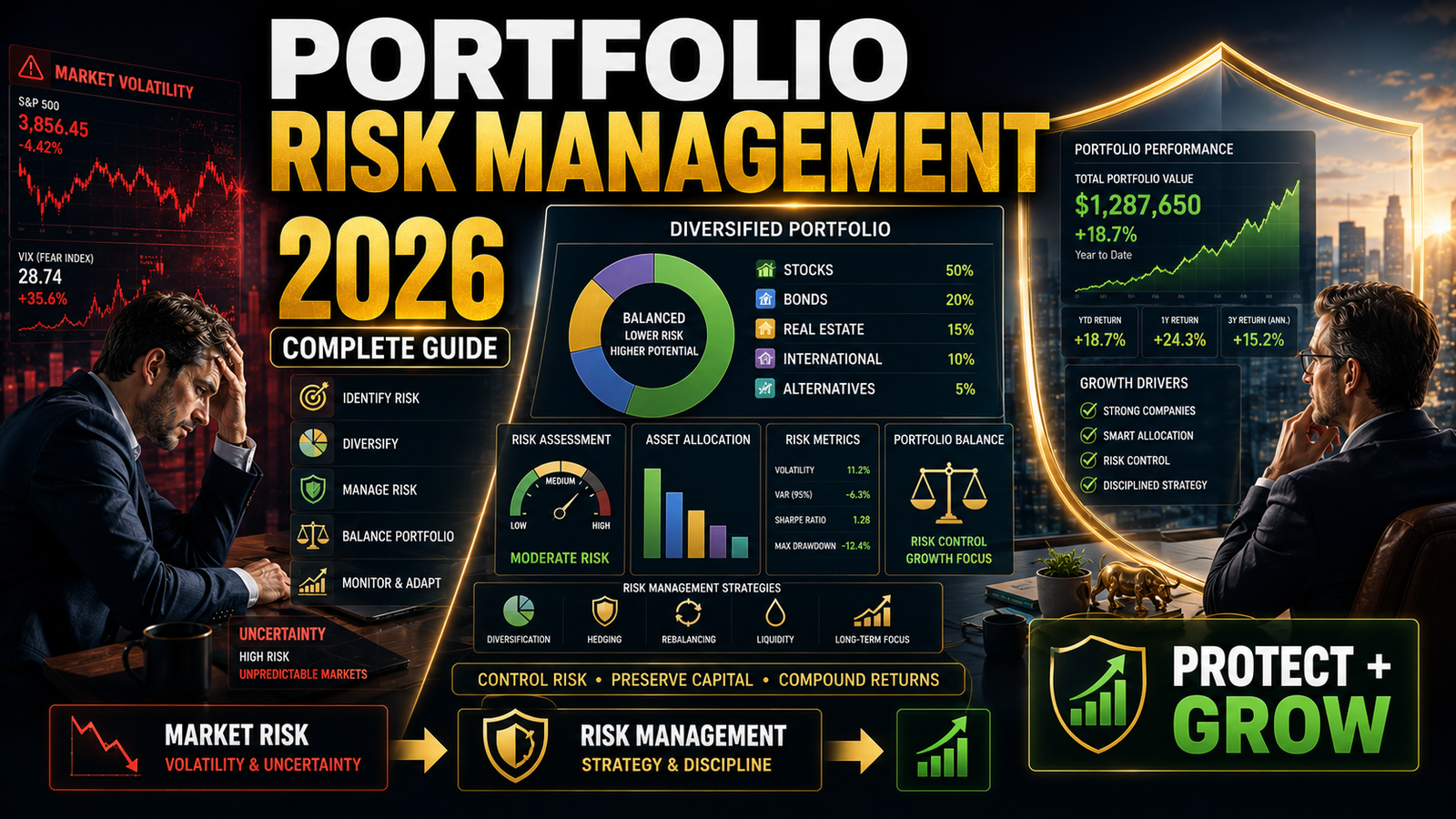
Investing is inherently uncertain. Markets rise and fall, economies shift, and unexpected events can wipe out years of gains in days. Yet, successful investors understand that risk is not something to fear – it is something to manage. Portfolio risk management is the art and science of identifying, measuring, and controlling the uncertainties that threaten investment returns.
In 2026, portfolio risk management has become more critical than ever. Geopolitical tensions, inflationary pressures, technological disruption, and climate risks are creating unprecedented volatility. According to a 2025 report, the global portfolio risk management market continues to grow as investors seek sophisticated tools to navigate turbulent markets.
Risk management is not about eliminating risk – that is impossible. It is about understanding the risks you are taking, ensuring you are adequately compensated for them, and protecting your portfolio against catastrophic losses. Whether you are an individual investor, a family office, or an institutional fund, effective risk management is the foundation of long-term investment success.
In this complete guide, we will walk you through everything you need to know about portfolio risk management. You will learn what portfolio risk is, the different types of risks, how to measure risk, strategies to manage it, common mistakes to avoid, and advanced techniques for sophisticated investors. By the end, you will have a comprehensive framework for protecting and growing your investments.
WHAT IS PORTFOLIO RISK?
Portfolio risk refers to the potential for the actual returns of an investment portfolio to deviate from expected returns. It encompasses the uncertainty and volatility inherent in financial markets and the possibility of losing part or all of your investment.
At its core, portfolio risk is about the probability and magnitude of losses. A riskier portfolio has a wider range of possible outcomes – both positive and negative. Risk management aims to ensure that the risks you take are deliberate, understood, and appropriately compensated.
Key characteristics of portfolio risk include:
- Uncertainty: The future is inherently unpredictable, and all investments carry some degree of uncertainty.
- Volatility: Prices and returns fluctuate over time, creating both opportunities and risks.
- Downside Potential: The possibility of losing money is the most concerning aspect of risk.
- Correlation: How different investments move in relation to each other affects overall portfolio risk.
- Time Horizon: Risk perception and tolerance vary with investment timeframes.
WHY PORTFOLIO RISK MANAGEMENT MATTERS IN 2026
Portfolio risk management has become more important than ever in today’s complex environment.
Market Volatility and Uncertainty
Global markets have experienced significant volatility in recent years. Geopolitical tensions, economic policy shifts, supply chain disruptions, and technological disruption create uncertainty that can rapidly impact portfolio values. Effective risk management helps investors weather these storms.
Inflation and Rising Interest Rates
After years of low inflation and near-zero interest rates, 2026 presents a different landscape. Rising costs erode purchasing power, and higher interest rates affect bond prices and discount rates. Risk management must account for these macroeconomic factors.
Geopolitical Risks
Trade disputes, regional conflicts, and political instability create risks that transcend traditional financial models. Diversification across geographies and asset classes is essential.
Regulatory Changes
Financial regulations continue to evolve. Compliance with standards like Basel III, MiFID II, and ESG disclosure requirements is increasingly important for institutional investors.
Behavioral Biases
Investors are human, and emotions often drive poor decisions. Panic selling during market downturns and euphoric buying during bubbles can destroy wealth. Risk management provides the discipline to stay the course.
The Need for Resilience
Building resilience into portfolios – the ability to withstand shocks – is a key priority. Risk management ensures that portfolios are not overly exposed to any single risk factor.
TYPES OF PORTFOLIO RISK
Understanding the different types of risk is the first step to managing them effectively.
1. Market Risk (Systematic Risk)
Market risk is the risk of losses due to broad market movements that affect all investments to some degree. It includes:
- Equity Risk: The risk that stock prices decline due to market conditions.
- Interest Rate Risk: The risk that bond prices fall when interest rates rise.
- Currency Risk (FX Risk): The risk that exchange rate fluctuations affect international investments.
- Commodity Risk: The risk that commodity prices fluctuate, impacting related investments.
Market risk is systemic and cannot be eliminated through diversification, though it can be managed through asset allocation and hedging.
2. Credit Risk
Credit risk is the risk that a borrower or counterparty fails to meet their obligations. It primarily affects bonds and debt instruments, but also impacts counterparties in derivatives transactions. A subset of credit risk, interest rate risk, highlights the sensitivity of a bond’s price to changes in interest rates.
3. Liquidity Risk
Liquidity risk is the risk that an asset cannot be sold quickly at its fair value. This can be particularly problematic during market stress when liquidity dries up, forcing investors to sell at fire-sale prices.
4. Inflation Risk
Inflation risk is the risk that rising prices erode the purchasing power of your investments. This is especially concerning for fixed-income investments that pay a fixed return over time.
5. Event Risk
Event risk is the risk of sudden, unexpected events that can dramatically impact markets. Examples include natural disasters, political crises, and corporate scandals. While difficult to predict, portfolios can be structured to be resilient to such events.
6. Behavioral Risk
Behavioral risk is the risk that investors make poor decisions due to emotions or cognitive biases. This includes panic selling, chasing past performance, and overconfidence. Risk management includes safeguards against these tendencies.
HOW TO MEASURE PORTFOLIO RISK
Effective risk management requires quantification. Several key metrics are used to measure portfolio risk.
Standard Deviation
Standard deviation measures the dispersion of returns around the average. Higher standard deviation indicates higher volatility and risk. It is one of the most widely used risk metrics.
Beta
Beta measures the sensitivity of a portfolio or security to market movements. A beta of 1 indicates the portfolio moves in line with the market. A beta above 1 indicates higher volatility than the market, while below 1 indicates lower volatility.
Value at Risk (VaR)
Value at Risk estimates the maximum potential loss over a specific time period at a given confidence level. For example, a 1-day 95% VaR of $100,000 means there is a 5% chance of losing more than $100,000 in a single day.
Conditional Value at Risk (CVaR)
CVaR measures the expected loss beyond the VaR threshold. It provides a more complete picture of tail risk.
Drawdown
Drawdown measures the peak-to-trough decline in portfolio value. Maximum drawdown is a key risk metric, particularly for investors with short time horizons or high liquidity needs.
Stress Testing and Scenario Analysis
Stress testing evaluates how a portfolio would perform under extreme market conditions, such as a severe recession or a sudden interest rate spike. Scenario analysis considers the impact of specific events or changes in market variables.
Diversification Metrics
Assess the diversification of your portfolio by examining correlations between assets. Lower correlations indicate better diversification and lower overall risk.
STRATEGIES FOR MANAGING PORTFOLIO RISK
Once risks are identified and measured, the next step is to implement strategies to manage them.
1. Asset Allocation
Asset allocation is the most important risk management decision. By distributing investments across asset classes – such as stocks, bonds, real estate, and alternatives – you reduce exposure to any single risk factor. The optimal allocation depends on your risk tolerance, time horizon, and financial goals.
2. Diversification
Diversification involves spreading investments across different sectors, geographies, and asset types. The principle is simple: not putting all your eggs in one basket. Diversification reduces the impact of any single investment’s poor performance.
However, true diversification requires understanding correlations. Two funds that appear diversified may have overlapping exposures that increase risk. Professional advisors use sophisticated tools to analyze true diversification.
3. Rebalancing
Over time, market movements cause portfolio allocations to drift from their targets. Rebalancing involves periodically buying and selling assets to restore the target allocation. This discipline ensures the portfolio does not become excessively risky or conservative.
4. Hedging
Hedging uses financial instruments like options and futures to protect against downside risk. Hedging acts like insurance – it has a cost but provides protection against significant losses. For example, put options on a stock index can limit losses during market downturns.
5. Risk-Adjusted Return Evaluation
Evaluate investments based on risk-adjusted returns, not just returns. Metrics like the Sharpe Ratio, which measures excess return per unit of risk, help ensure you are being adequately compensated for the risks you take.
6. Liquidity Management
Maintain adequate liquidity to meet unexpected needs without being forced to sell volatile assets at a loss. This includes holding cash or highly liquid securities.
7. Continuous Monitoring
Risk management is not a one-time exercise. Markets change, personal circumstances evolve, and new risks emerge. Regular portfolio reviews and risk assessments are essential.
8. Working with Professional Advisors
For many investors, risk management is too complex to handle alone. Financial risk advisors provide expert assessment, customized strategies, access to advanced tools, continuous monitoring, and emotional guardrails against impulsive decisions.
THE ROLE OF MODERN PORTFOLIO THEORY
Modern Portfolio Theory (MPT), developed by Harry Markowitz, provides a framework for constructing portfolios that maximize expected return for a given level of risk.
Key Principles of MPT
- Efficient Frontier: The set of portfolios offering the highest expected return for a given risk level.
- Diversification: Combining assets with low correlations reduces overall portfolio risk.
- Risk-Return Trade-Off: Higher expected returns require taking higher risk.
Limitations of MPT
While MPT is foundational, it has limitations. It assumes returns are normally distributed, which is not always the case. It also relies on historical data, which may not predict future correlations.
ADVANCED RISK MANAGEMENT TECHNIQUES
For sophisticated investors, advanced techniques are available.
Algorithmic Trading and Machine Learning
Algorithms and machine learning models can identify patterns, predict risks, and execute adjustments in real-time. Automated trading systems minimize human error and optimize efficiency.
Scenario Planning for Cash Flow
Scenario planning extends risk management to the cash flow dimension. By modeling working capital assumptions under different scenarios – base, upside, downside, and stress – investors and businesses can anticipate liquidity needs and covenant compliance.
Covenant Testing
For leveraged investors, testing loan covenants under different scenarios is critical. A stress case that triggers multiple covenant breaches can have severe consequences. Identifying potential breaches in advance allows time for renegotiation.
Software and Platforms
Several advanced platforms assist with portfolio risk management, including:
- MSCI RiskManager: Risk analytics for institutional investors
- Bloomberg PORT: Integrated risk analytics
- BlackRock Aladdin: Comprehensive risk and portfolio management
COMMON MISTAKES TO AVOID
Avoid these common errors in portfolio risk management.
Mistake 1: Ignoring Risk Entirely
Focusing solely on returns without considering risk is a recipe for disaster. High returns often come with high risk, and catastrophic losses can be devastating.
Mistake 2: Overestimating Diversification
Holding many investments does not guarantee diversification. Overlapping exposures can create hidden risks.
Mistake 3: Panic Selling
Selling during market downturns locks in losses and prevents recovery. Risk management should provide the discipline to stay invested.
Mistake 4: Chasing Past Performance
Investing in assets that have performed well recently often leads to buying at peak prices. This increases risk and reduces future returns.
Mistake 5: Neglecting Liquidity
Overinvesting in illiquid assets can create problems when cash is needed. Maintain adequate liquidity reserves.
Mistake 6: Failing to Re-evaluate
Risk tolerance and financial goals change over time. Regular reviews ensure the portfolio remains aligned with your circumstances.
FREQUENTLY ASKED QUESTIONS
What is portfolio risk management?
Portfolio risk management is the process of identifying, measuring, and controlling the uncertainties that could negatively impact investment portfolios. The goal is to maximize returns while maintaining an acceptable level of risk.
What are the main types of portfolio risk?
The main types include market risk, credit risk, liquidity risk, inflation risk, event risk, and behavioral risk. Each presents unique challenges to portfolio stability.
How do you measure portfolio risk?
Common metrics include standard deviation, beta, Value at Risk (VaR), Conditional Value at Risk (CVaR), drawdown, and stress testing.
What is the difference between systematic and unsystematic risk?
Systematic risk (market risk) affects all investments and cannot be diversified away. Unsystematic risk is specific to individual investments and can be reduced through diversification.
How does diversification reduce risk?
Diversification reduces risk by spreading investments across different assets, sectors, and geographies. If one investment performs poorly, others may perform well, reducing overall portfolio volatility.
What is rebalancing and why is it important?
Rebalancing involves periodically adjusting portfolio allocations back to target levels. It maintains the desired risk profile and enforces disciplined buying and selling.
Should I manage risk myself or hire a professional?
For complex portfolios or during volatile times, professional risk advisors provide expert assessment, advanced tools, continuous monitoring, and emotional discipline that can be valuable.
CONCLUSION
Portfolio risk management is the cornerstone of successful investing. It is not about avoiding risk entirely – that is impossible – but about understanding, measuring, and controlling risks to achieve your financial goals.
In 2026, risk management is more important than ever. Market volatility, geopolitical uncertainty, inflation, and technological disruption create a challenging environment. But with a disciplined approach – including asset allocation, diversification, rebalancing, hedging, and continuous monitoring – investors can protect their portfolios and position themselves for long-term growth.
Remember, risk management is not a one-time exercise. It is an ongoing process that adapts to changing markets and personal circumstances. Stay disciplined, stay diversified, and stay focused on your long-term goals.
Explore more investment and risk management guides on Akashhelps.com.
Disclaimer: This content is for informational and educational purposes only and does not constitute professional financial or investment advice. Always consult with a qualified financial advisor regarding your specific investment situation and risk tolerance. Akashhelps.com is not responsible for any losses or damages resulting from the use of this information.
Author Bio: This guide was written by the finance content team at Akashhelps.com, with expertise in portfolio management, risk analysis, and investment strategy. We are committed to providing accessible, accurate, and actionable financial education.
Last reviewed: August 2026
Sources:
- Hennion & Walsh – Managing Portfolio Risk Effectively
- Wright Research – Portfolio Risk Management 2025
- AlgoTradingLib – Portfolio Risk Management
- Onetribe Advisory – Scenario Planning for Cash Flow
- MSCI RiskManager – Risk Analytics